| ●Top | Hydrogen Permeable Metal Membrane | Category | Formula | Usage | Hydrogen Utilization |
A "hydrogen permeable metal membrane" is a metal membrane that only allows hydrogen to pass through. By
utilizing this characteristic, it is possible to produce very pure hydrogen.
When something passes through a membrane, it is natural to think that there are small holes, or
"pores", in the membrane through which it passes.
However, the hydrogen permeable metal membrane introduced here allows hydrogen
to pass through even though there are no small holes. It's very mysterious,
isn't it?
Why does this happen?
First, please take a look at the video and image below, which show hydrogen passing through metal.
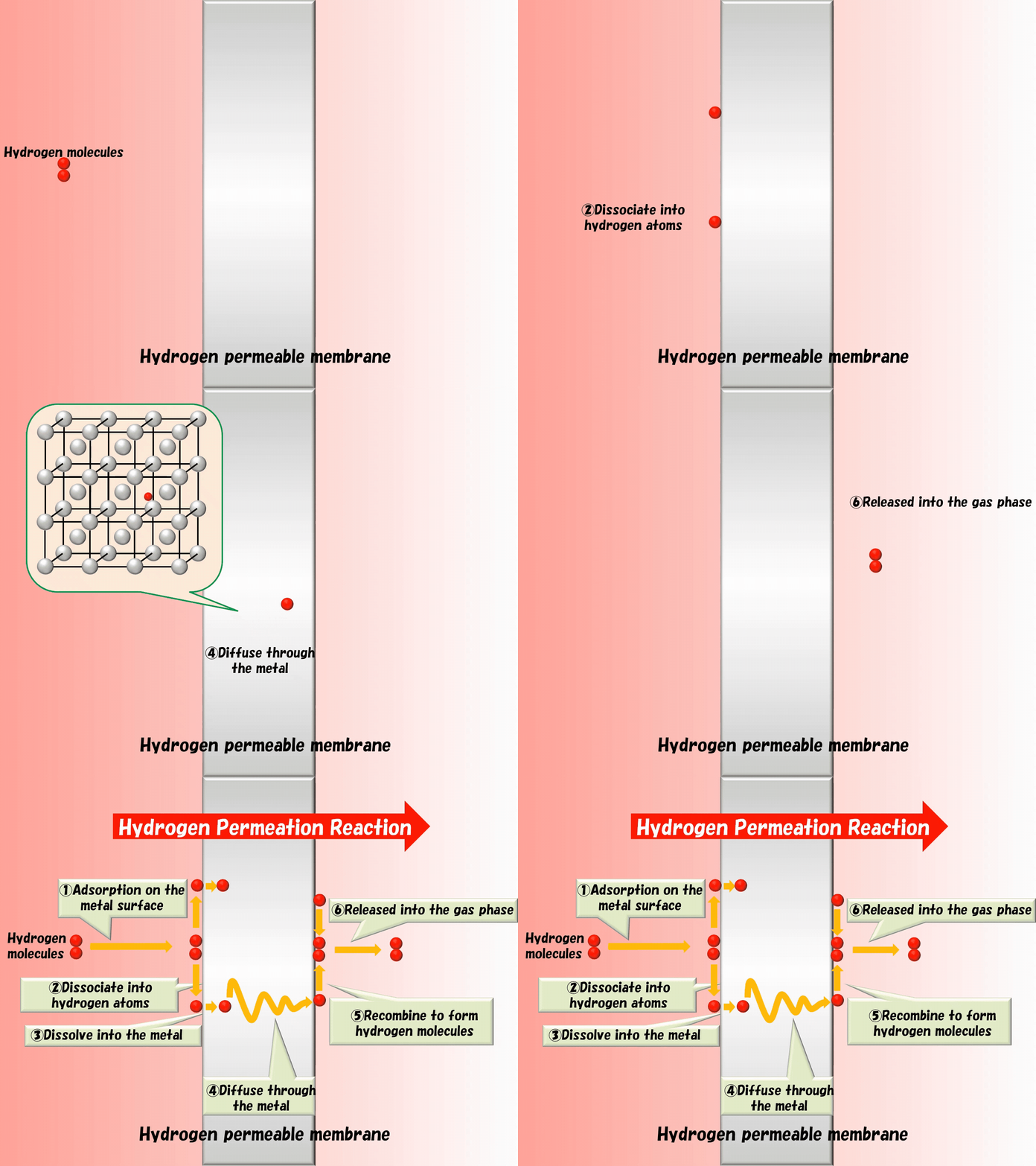
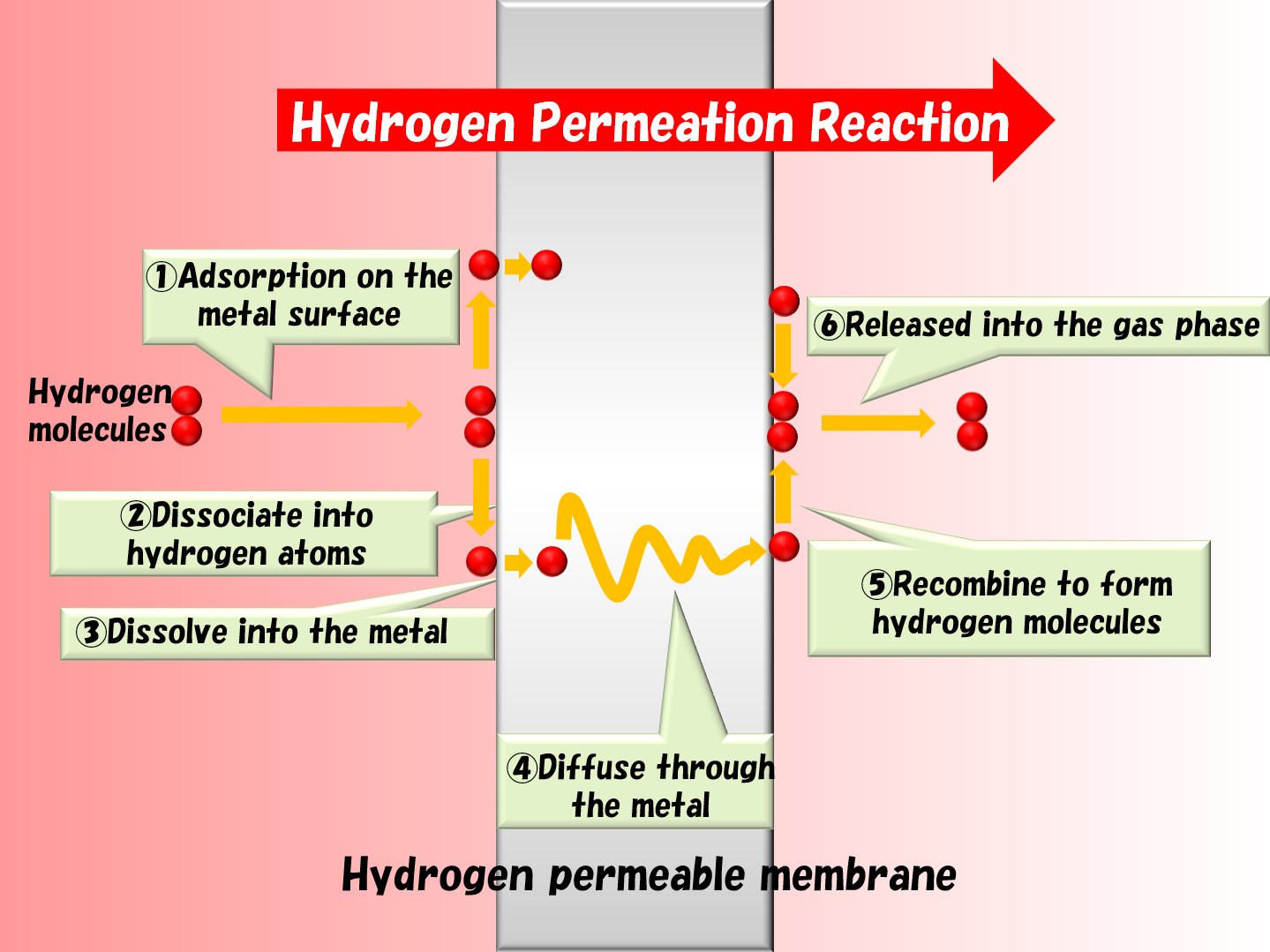
This is what happens when hydrogen passes through metal.
First, hydrogen exists as hydrogen molecules, which are two hydrogen atoms (one sphere each) bonded together, as shown by the two red spheres in the video and image. The air you breathe contains nitrogen and oxygen, which are also composed of two nitrogen atoms or two oxygen atoms bonded together, and these atoms are constantly moving around in large numbers.
To put it simply, it's like invisible atomic couples holding hands and going on a date together.
Now, this hydrogen couple (hydrogen molecule) has arrived in front of the
hydrogen permeable metal membrane. Hydrogen first sticks to the surface
of the metal. This is called "adsorption".
The adsorbed hydrogen couple then lets go of each other's hands! Yes, they
part ways. How sad. This parting is called "dissociation".
The hydrogen atoms that have been separated enter the metal. This is called "dissolution". Did you think it was strange that hydrogen could enter the membrane
even though I said earlier that it had no holes?
Yes, you are right. Let's take a look at metals. Please look at the figure
below.
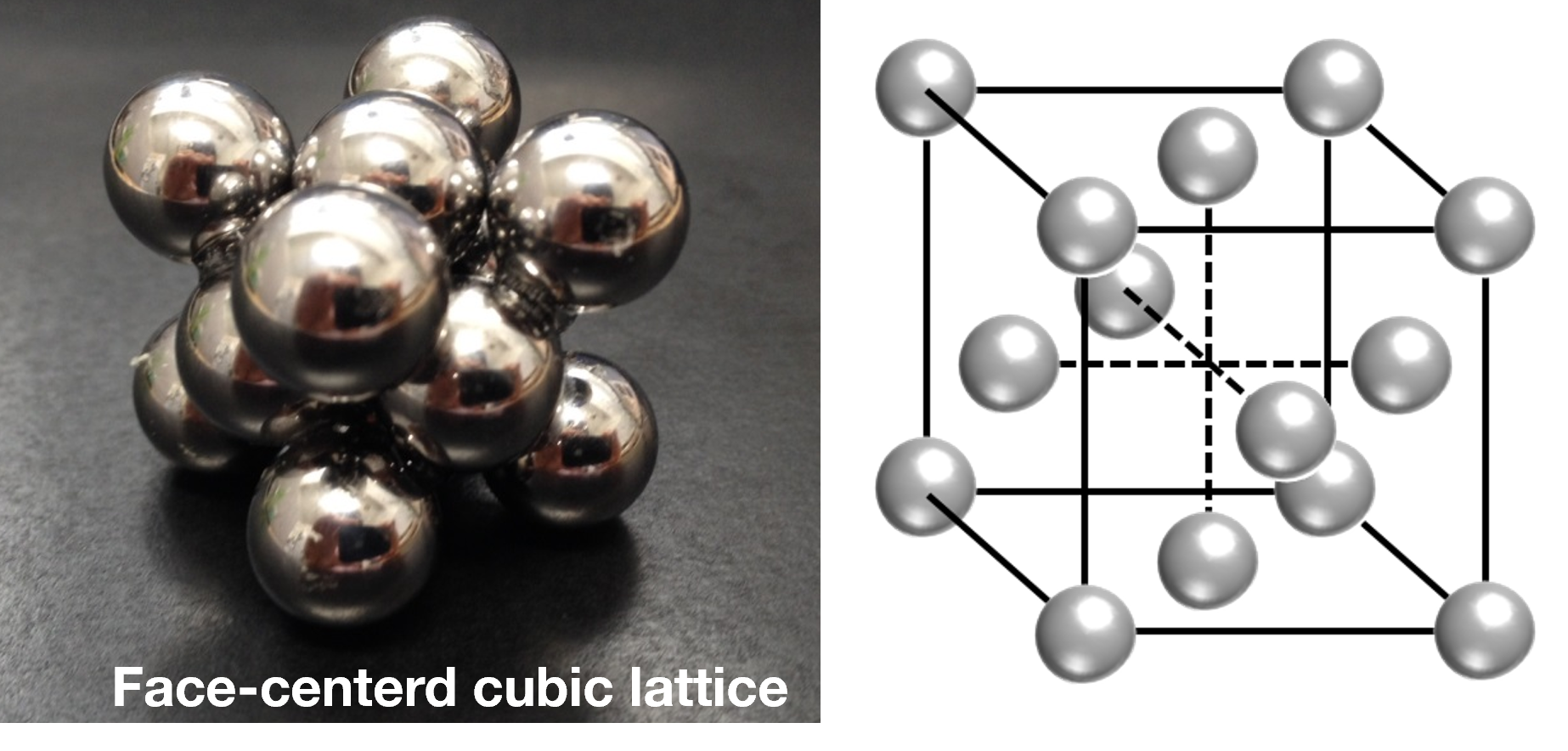
As shown in the figure, metal atoms are neatly arranged in a fixed pattern within metals.
Substances formed by atoms arranged in this neat pattern are called "crystals". In reality, there are many fixed patterns called “unit cells” like
the one shown in the figure above.
The example above is a unit cell called a “face-centered cubic lattice,”
in which atoms are located at the corners of the cube and at the centers
of each face.
Let's take a closer look inside the crystal. Please refer to the figure
below.
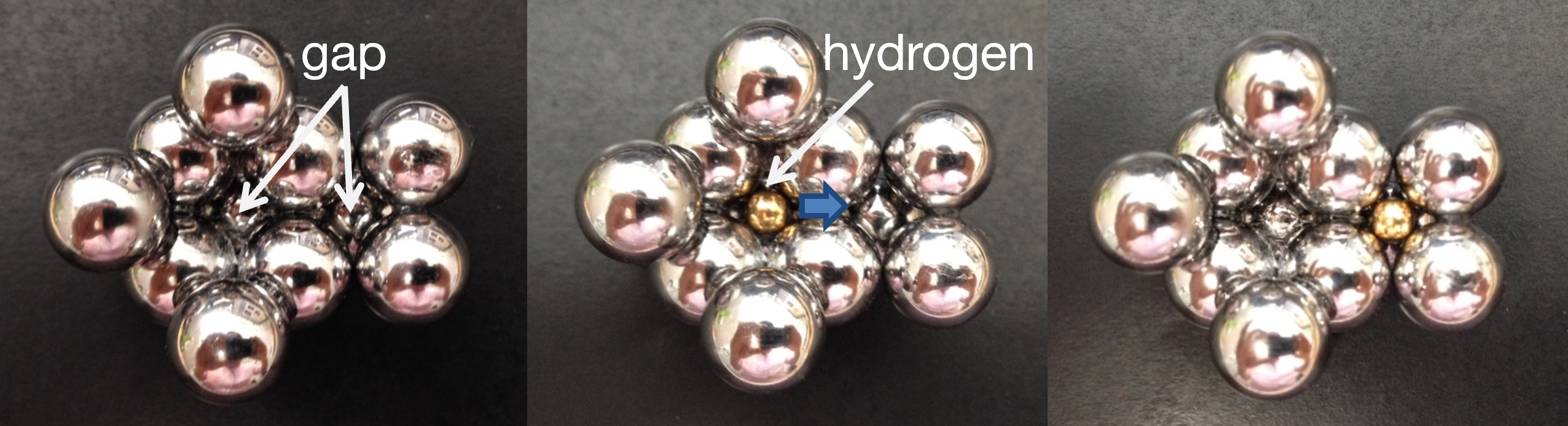
This diagram shows the face-centered cubic lattice from above, with another
lattice attached to it.
Since there are no atoms at the center of the face-centered cubic lattice,
there are “gaps” as shown in the photo. Hydrogen atoms enter these “gaps”.
This is the mechanism of dissolution.
These “gaps” are very small compared to so-called holes, so atoms other
than hydrogen cannot enter them. Therefore, at this point, almost no atoms
other than hydrogen remain.
Hydrogen dissolved in metal does not remain stationary. As shown in the photo on the right, it moves from one “gap” to the next, repeating this process to advance step by step.
This is called "diffusion".
As it passes through the membrane, it repeats this movement from one “gap” to the next approximately 10,000 to 100,000 times.
The other substances that entered during dissolution are unable to keep up with the movement of hydrogen because their diffusion is extremely slow compared to hydrogen.
In this way, the characteristic of hydrogen permeable metal membranes is
that they separate hydrogen and other substances through the two processes
of dissolution and diffusion, producing pure hydrogen.
After spreading out, the hydrogen atoms that reach the other side of the membrane reunite with their partners. They join hands once again.
This is called "recombination".
The hydrogen atoms that have successfully reunited as couples leave the metal. This is called "release", and now it is a world where only hydrogen atoms exist!
 |
☆ key point! A hydrogen permeable metal membrane is a metal membrane that only allows hydrogen to pass through. Hydrogen enters the gaps between metal atoms through a process called "dissolution", and then moves from gap to gap through a process called "diffusion". This allows only hydrogen to pass through the membrane, producing very pure hydrogen. |