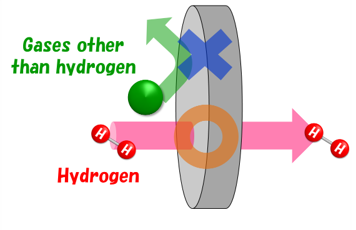
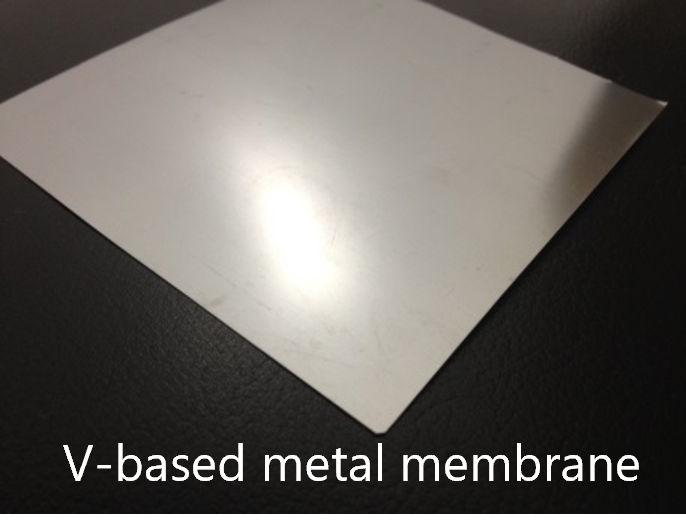
Here, we will explain how hydrogen permeable metal membranes are used.
First, let's look at the characteristics of hydrogen permeable metal membranes.
1. They can produce very pure hydrogen.
2. They can separate hydrogen using a simple mechanism.
3. Only hydrogen can pass through them.
4. Hydrogen emerges on the opposite side of the membrane in atomic form.
By leveraging these characteristics, various purposes and uses can be developed.
First, let's look at the first feature: "It can produce very clean hydrogen". Environmental issues are currently a major concern, and there is a global movement to utilize hydrogen as a clean energy source.
For example, one of the most representative uses of hydrogen is in fuel cells, which generate electricity through a chemical reaction between hydrogen and oxygen.
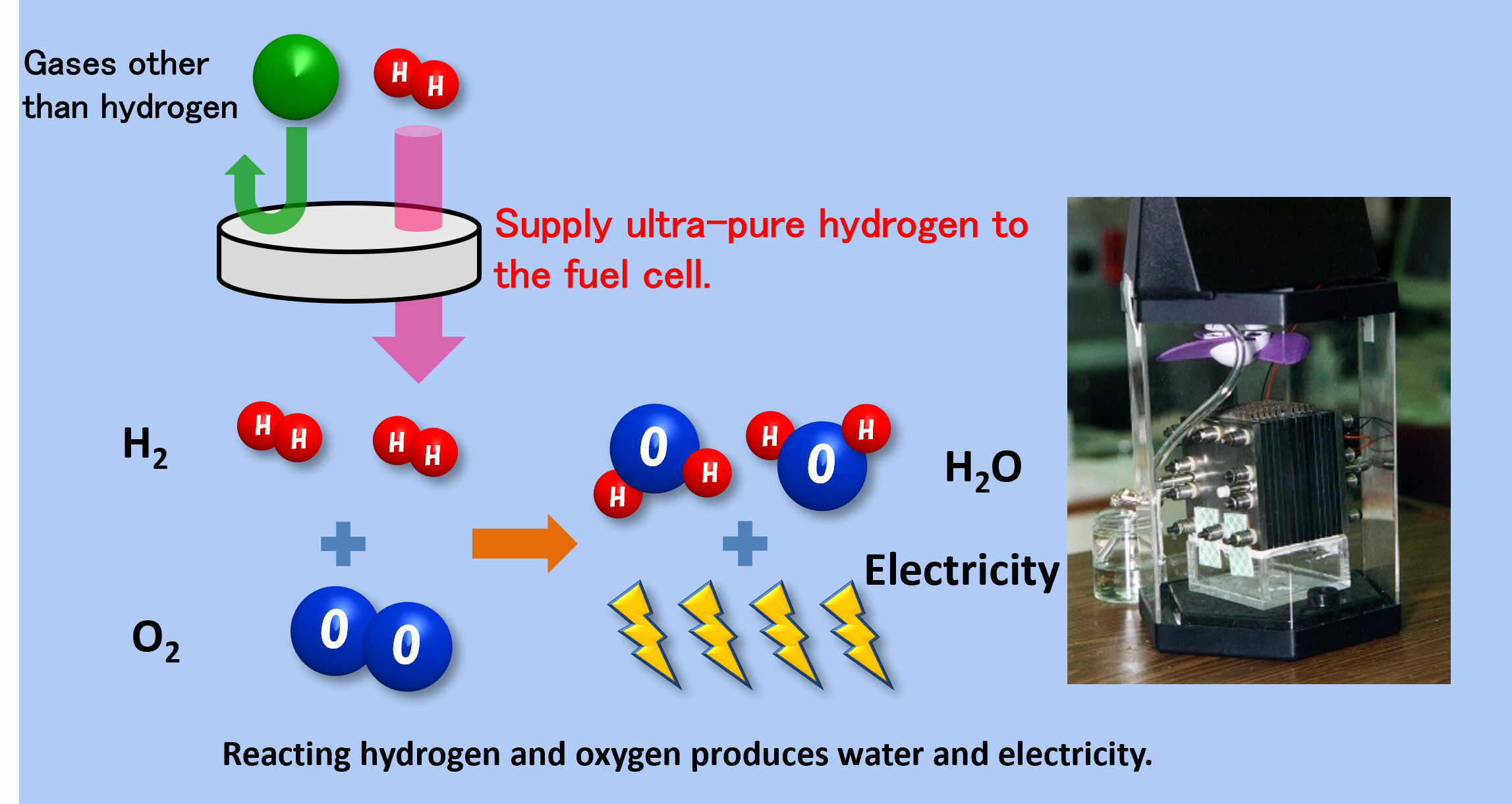
Fuel cell
When hydrogen and oxygen react, water is produced. Conversely, this means it only produces water and does not emit carbon dioxide, which is considered a cause of global warming.
Therefore, it is said to be a very environmentally friendly method of power generation. Cars powered by this fuel cell are now being manufactured.

Fuel cell bus / car
Today's cars won't run unless you fill them up with gasoline at a gas station, and fuel cell vehicles won't run unless you fill them with hydrogen. Hydrogen stations for filling up with hydrogen are gradually being built.
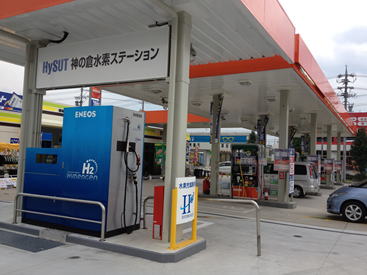
Hydrogen station
The hydrogen used in fuel cells must be extremely pure.
Therefore, hydrogen-permeable metal membranes capable of producing pure hydrogen are crucial materials.
In the future, the hydrogen you fill up with at these hydrogen stations might be hydrogen purified by passing through such membranes.
Moreover, extremely pure hydrogen has other uses. For example, it is indispensable in semiconductor manufacturing.
Next is the second feature: “Hydrogen can be separated using a simple mechanism.”
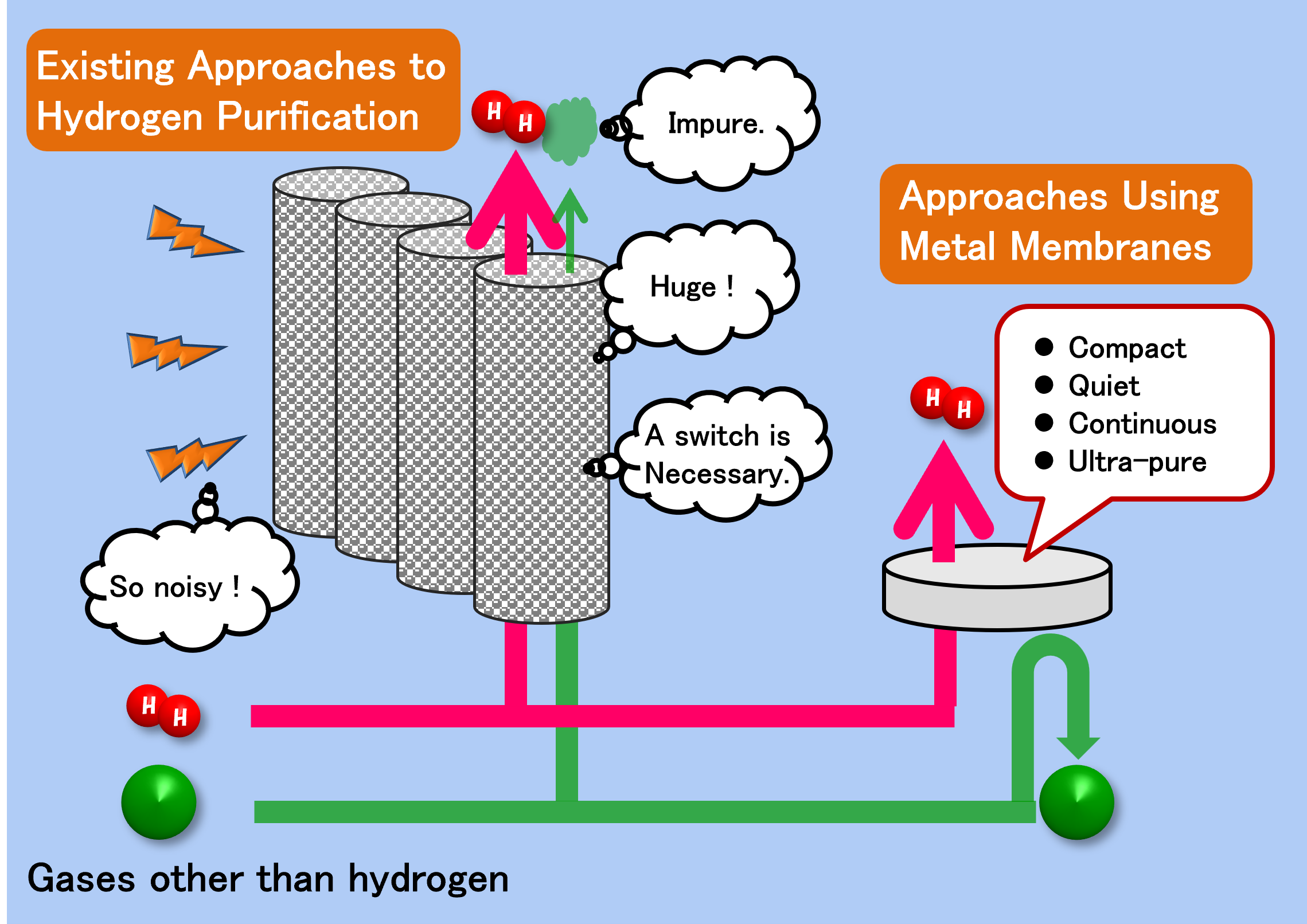
Comparison with Conventional PSA
The equipment currently used to produce hydrogen employs a method called PSA (Pressure Swing Adsorption).
This method captures impurities other than hydrogen using an adsorbent to produce pure hydrogen. However, this method has several drawbacks.
1. High noise levels.
2. The device itself is large and takes up too much space.
3. It can produce fairly clean hydrogen, but the purity is not sufficient.
4. There is a limit to the amount of impurities that can be adsorbed, requiring the adsorbent to be replaced.
On the other hand, as explained on the “What is a Hydrogen Permeable Metal Membrane?” page, hydrogen permeable metal membranes allow only hydrogen to pass through, enabling the production of sufficiently pure hydrogen.
Furthermore, they produce no noise whatsoever during hydrogen permeation and can be designed very compactly.
Additionally, they require no switching and can operate continuously.
Due to these advantages, hydrogen permeable membranes may potentially replace PSA-type hydrogen production equipment in the future.
Next is the third characteristic: “Only hydrogen can pass through the membrane.”
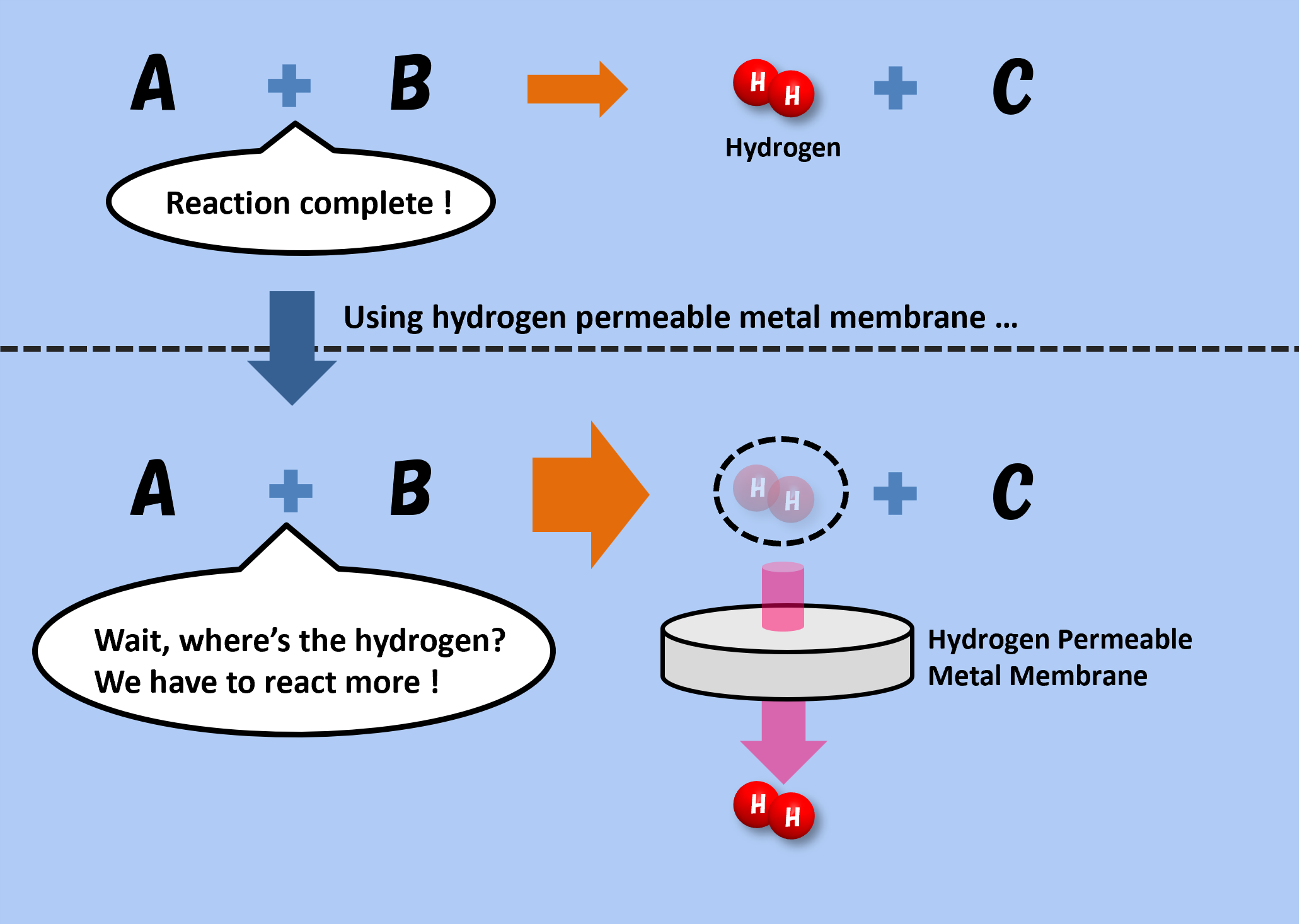
Membrane reactor
Hydrogen does not exist in nature in its pure form, so it must be produced through some chemical reaction.
However, chemical reactions have a fixed efficiency determining how much reaction occurs.
Consider substances A and B reacting to produce hydrogen and C, as shown in the diagram above.
When the reaction progresses to a certain point, A and B think, “We did our job~. Reaction complete,” and ultimately only a fixed amount of hydrogen is produced.
However, if there is a hydrogen permeable metal membrane that only allows hydrogen to pass through, even after the reaction occurs and hydrogen is produced, only the hydrogen escapes through the membrane.
Consequently, the substances mistakenly think, “Huh? The reaction isn't over yet,” and continue reacting to produce more hydrogen.
This results in much higher efficiency compared to when no hydrogen-permeable metal membrane is present.
This mechanism using a hydrogen permeable metal membrane is called a "membrane reactor".
Another application is the “hydrogen sensor".
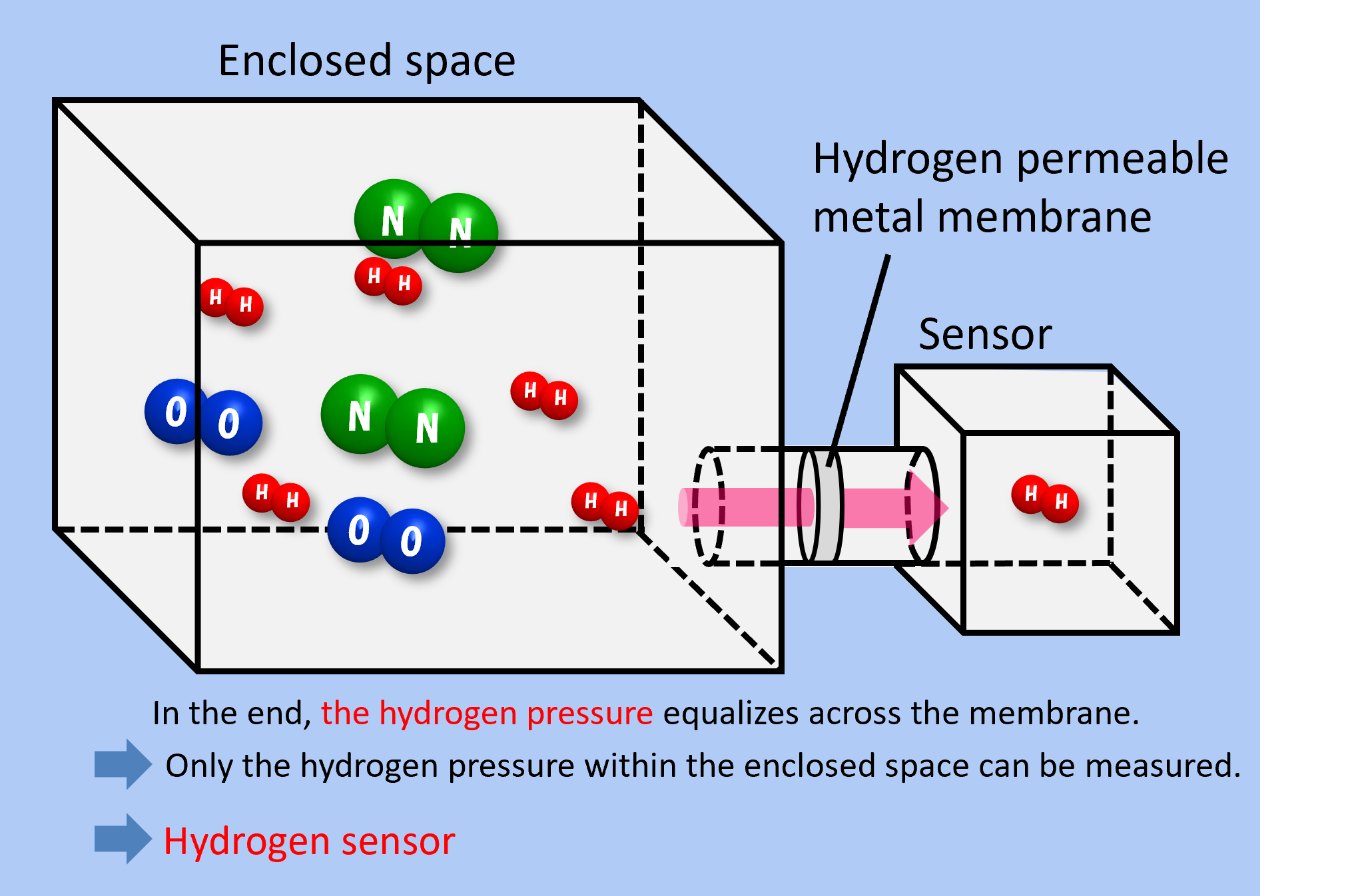
Hydrogen sensor
A device that measures how much of a specific substance is present is called a “sensor.”
By using a hydrogen permeable metal membrane, we can create a “hydrogen sensor” that detects hydrogen.
As shown in the figure above, suppose hydrogen is present in a chamber, and we want to know its quantity.
If we bring a hydrogen permeable metal membrane into that chamber, only the hydrogen will pass through the membrane and accumulate on the sensor side.
Eventually, the hydrogen pressure inside the chamber and inside the sensor will equalize.
By measuring the pressure inside the sensor at that point, we can determine the amount of hydrogen in the chamber.
Using a hydrogen permeable metal membrane allows us to detect only hydrogen, regardless of other gases present, making it suitable for use as a “hydrogen sensor.”
Finally, the fourth point: “Hydrogen emerges on the opposite side of the membrane in its atomic state.” As explained in “What is a Hydrogen permeable metal membrane?”, hydrogen exists as hydrogen molecules, which are pairs of hydrogen atoms. Separating this close-knit pair is inherently very difficult.
However, with a hydrogen permeable metal membrane, hydrogen that has become atomic dissolves and diffuses through the metal, passes to the opposite side, and recombines there to return to a molecular state.
Consequently, the surface on the opposite side of the membrane contains a large amount of hydrogen that has not yet returned to a molecular state.
This hydrogen wanders around searching for a partner to recombine with.
By blowing a different substance onto this surface, you can react it with the hydrogen searching for a partner, creating an entirely different substance.

Use as a reactor
Hydrogen permeable metal membranes have various applications and uses.
Further research may lead to even more novel applications in the future.
 |
☆ Key points! Hydrogen permeable metal membranes not only produce pure hydrogen but can also be applied to hydrogen sensors and novel chemical reactors. Hydrogen permeable metal membranes have various applications and uses. Further research may lead to even more novel applications in the future. |